The most expensive home gym mistake is buying equipment before deciding what it is for. The second most expensive is buying a lot of equipment that does a little, instead of a little equipment that does a lot. This guide is about avoiding both.
What you actually need
Start with the goal. The World Health Organization's 2020 guidelines recommend that adults do muscle-strengthening activity involving the major muscle groups on two or more days a week, alongside regular aerobic activity (Bull et al., 2020). A meta-analysis of cohort studies found that muscle-strengthening activity was associated with a 10–17% lower risk of all-cause mortality, cardiovascular disease, total cancer, diabetes and lung cancer. For all-cause mortality, cardiovascular disease and total cancer, the largest risk reductions appeared at around 30 to 60 minutes a week (Momma et al., 2022). Those are observational associations, not proof of cause and effect, but they point the same way as decades of training research on the benefits of strength training for health and function (Westcott, 2012).
The equipment needed to meet that goal is modest. Two findings make home training especially practical.
- The type of equipment matters less than you might think. A meta-analysis comparing free weights and machines found similar gains in muscle size and overall strength (Haugen et al., 2023). The 2026 American College of Sports Medicine position stand found that equipment type did not consistently change training outcomes (Currier et al., 2026).
- You do not need very heavy weights to build muscle. When sets are taken close to failure, lighter and heavier loads produce similar muscle growth, although heavier loads build more maximal strength (Schoenfeld et al., 2017; Lopez et al., 2021). Researchers have pointed out that being able to choose your own load makes effective home training realistic (Fisher et al., 2017).
In short, a home gym needs enough resistance to make your sets hard, enough variety to train every major muscle group, and a safe way to train close to failure.
Plan the space before the equipment
- Measure the room, including the space around each piece. Benches and racks need room to load plates and move around them.
- Check the ceiling height for overhead pressing and pull-ups.
- Protect the floor. Rubber flooring protects tiles and wood, reduces noise and makes the area safer.
- Think about floor loading. Racks, plate storage and heavy machines concentrate a lot of weight in a small area. On upper floors, check with your building management, or a structural engineer for very heavy equipment, before you buy.
- Consider noise and neighbours, particularly in apartments. Avoid dropping weights and choose rubber-coated plates and dumbbells where noise matters.
- Ventilate the space. Good airflow keeps you comfortable and helps prevent rust on equipment.
- Check the power supply for cardio machines. Treadmills especially may need a dedicated circuit. In India, confirm that any machine suits a 230 V, 50 Hz supply.
- Check the delivery route, including doors, lifts, stairs and corners, for anything large or heavy.
Spend in stages
Most home gyms begin with a modest budget. The best approach is to put that budget into the equipment that does the most, and add to it over time.
Stage 1: the foundation
An adjustable bench and a set of dumbbells, plus protective flooring. With these you can train every major muscle group: presses, rows, split squats, Romanian deadlifts, curls, extensions and more. Choose a dumbbell range wide enough to make your sets hard, or a pair of adjustable dumbbells if space is tight. A sturdy, well-made bench matters more than most people think, because you will use it for nearly everything.
Stage 2: the strength corner
A barbell, plates and a half rack or squat rack with safety arms. This lets you squat, bench press and overhead press heavily and safely when you train alone. The safety arms are not optional. They are what make hard sets safe without a spotter.
Stage 3: cables
A functional trainer or cable column adds pulldowns, rows, cable flyes, overhead triceps work and dozens of other movements in a modest footprint. For many home gyms, this is the most versatile single addition after the basics.
Stage 4: the machines that suit you
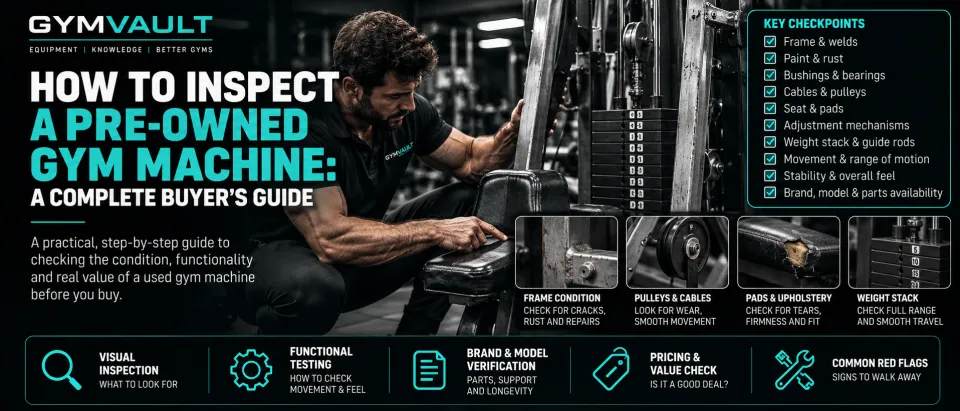
Once the foundation is in place, add one or two machines for your priorities, such as a seated leg curl, a leg press or a lat pulldown. This is where pre-owned commercial equipment can make particular sense, because you get a durable, smooth machine for less than the cost of buying new.
Cardio, if you want it
A rower or an air bike gives a hard cardiovascular workout in a small space without needing a dedicated electrical circuit. A treadmill needs more space and power, but many people find it the cardio machine they actually use.


Home equipment or commercial equipment?
Commercial equipment is built for heavy shared use, with sturdier frames and wear parts designed to be replaced. In a home that means a better feel, a longer life and better resale value. The trade-offs are size, weight, cost and more complicated delivery. Pre-owned commercial equipment narrows the cost gap, which is why many serious home trainers buy fewer, better pieces rather than more home-grade ones. Free weights are especially good pre-owned buys, because well-made dumbbells, bars and plates last for decades with almost no maintenance.
Before you buy any large commercial machine for a home, check its dimensions and weight against your room and the delivery route. We list these where they are verified, and we confirm them with you before quoting.
Three home gyms that work
| Layout | Equipment | Suits |
|---|---|---|
| The compact corner | Adjustable bench, dumbbells, flooring | Apartments, beginners, full-body training two to four times a week |
| The strength room | Half rack with safeties, barbell and plates, adjustable bench, dumbbells, flooring | People who want to train heavy squats, presses and pulls alone |
| The machine room | Functional trainer, adjustable bench, dumbbells, one or two commercial machines | People who prefer machines, or who are training around past injuries with professional guidance |
Mistakes to avoid
- Buying for exercises you do not enjoy. You will not use them.
- Skipping safeties on a rack, or training heavy without them.
- Ignoring the floor until a dropped dumbbell cracks a tile.
- Buying too narrow a weight range and outgrowing it within months.
- Buying the largest machine first before you have the foundation in place.
References
- Bull FC, Al-Ansari SS, Biddle S, et al. World Health Organization 2020 guidelines on physical activity and sedentary behaviour. Br J Sports Med. 2020;54(24):1451–1462. doi:10.1136/bjsports-2020-102955
- Currier BS, D'Souza AC, Singh MAF, et al. American College of Sports Medicine position stand. Resistance training prescription for muscle function, hypertrophy, and physical performance in healthy adults: an overview of reviews. Med Sci Sports Exerc. 2026;58(4):851–872. doi:10.1249/MSS.0000000000003897
- Fisher J, Steele J, Smith D. High- and low-load resistance training: interpretation and practical application of current research findings. Sports Med. 2017;47(3):393–400. doi:10.1007/s40279-016-0602-1
- Haugen ME, Vårvik FT, Larsen S, et al. Effect of free-weight vs. machine-based strength training on maximal strength, hypertrophy and jump performance: a systematic review and meta-analysis. BMC Sports Sci Med Rehabil. 2023;15(1):103. doi:10.1186/s13102-023-00713-4
- Lopez P, Radaelli R, Taaffe DR, et al. Resistance training load effects on muscle hypertrophy and strength gain: systematic review and network meta-analysis. Med Sci Sports Exerc. 2021;53(6):1206–1216. doi:10.1249/MSS.0000000000002585
- Momma H, Kawakami R, Honda T, Sawada SS. Muscle-strengthening activities are associated with lower risk and mortality in major non-communicable diseases: a systematic review and meta-analysis of cohort studies. Br J Sports Med. 2022;56(13):755–763. doi:10.1136/bjsports-2021-105061
- Schoenfeld BJ, Grgic J, Ogborn D, Krieger JW. Strength and hypertrophy adaptations between low- vs. high-load resistance training: a systematic review and meta-analysis. J Strength Cond Res. 2017;31(12):3508–3523. doi:10.1519/JSC.0000000000002200
- Westcott WL. Resistance training is medicine: effects of strength training on health. Curr Sports Med Rep. 2012;11(4):209–216. doi:10.1249/JSR.0b013e31825dabb8
Further reading
- Free weights vs machines: what the evidence says
- What "commercial grade" really means
- Browse benches and racks
- Browse dumbbells and free weights
This article is general information about training and equipment. It is not medical advice. Speak to a qualified professional before starting a new exercise programme, particularly if you have an injury, a health condition or have been inactive.