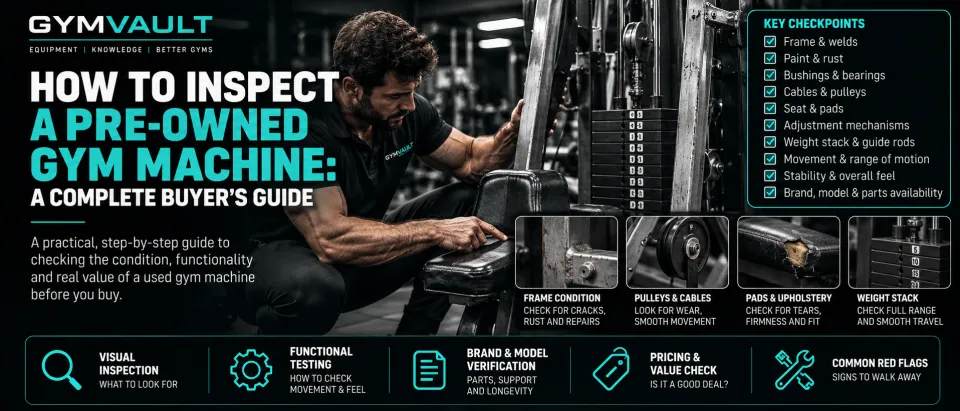
Two sellers can describe the same machine as "refurbished" and mean entirely different things. One has stripped the frame, refinished it, fitted new cables, new bearings and new upholstery. The other has cleaned it and tightened a few bolts. Both are using the word honestly by their own standards, which is exactly the problem.
At GYMVAULT we solve this by describing every unit we hold with two separate facts, and by never letting either one stand in for a working machine.
Two facts, not one
The condition grade: how it looks
A condition grade describes a machine's appearance: paint, frame finish, upholstery, grips and decals. We use three grades, A, B and C, ranging from excellent presentation with minimal cosmetic wear to more noticeable cosmetic wear that is clearly disclosed. The exact wording of each grade is published on our quality process page.
Three rules sit above the grades:
- A grade never excuses a mechanical fault. Every graded unit must pass our full functional inspection first. A Grade C machine is mechanically sound. It simply shows its age.
- Grades are assigned by a person after a hands-on inspection, never from photographs alone.
- Every cosmetic imperfection we know about is listed and photographed on the product page.
The restoration level: what was done
The restoration level describes the work carried out on the unit.
- Serviced: cleaned, inspected, adjusted and lubricated. Worn parts are replaced only where they affect safety or function.
- Refurbished: everything in Serviced, plus renewal of wear parts and cosmetics as needed, such as upholstery, grips, cables or belts, pulleys, decals and paint touch-up.
- Restored: stripped down, frame refinished, upholstery replaced and wear parts renewed throughout. We use this word only when that work has actually been done.
Each product page then lists the specific work carried out on that unit, because "refurbished" should come with a list, not just a label.
Why we keep them separate
Combining condition and restoration into a single score hides useful information. A Grade B machine that has only been serviced and a Grade B machine that has been fully refurbished look similar, but the second has new wear parts and probably a longer trouble-free life ahead of it. Keeping the two apart lets you decide what matters for your situation.
- For a busy commercial floor, mechanical renewal matters more than perfect paint. A refurbished Grade B or C machine can be excellent value.
- For a home gym or a premium hotel, appearance matters more, and a Grade A unit, or a restored one, may be worth the extra cost.
- For a member-facing showpiece, such as the first machine people see when they walk in, restoration and a high grade together make sense.


Questions to ask any seller who says "refurbished"
- Which parts were replaced? Ask about cables or belts, pulleys, bearings and bushings, grips and upholstery.
- Were the replacement parts from the original manufacturer or compatible alternatives? Both can be fine, but you should know which.
- Was the frame refinished, and how? A full strip and refinish is a very different job from a touch-up.
- What was inspected and tested? Ask for the checklist, not just the result.
- What cosmetic imperfections remain? Ask for photographs of each.
- What are the after-sales terms for this unit, and are they written into the quotation?
A seller who answers these questions clearly, in writing and with photographs, is giving you far more assurance than any label.
What makes equipment last
Commercial equipment is built to be maintained, and maintenance is what decides how long it lasts. The American College of Sports Medicine's facility standards include sample maintenance schedules and checklists, which are a good starting point for any facility (ACSM, 2019). The essentials are simple:
- Clean contact surfaces regularly with products suitable for the upholstery and grips, because harsh chemicals can crack vinyl over time.
- Keep guide rods clean and lubricated as the manufacturer recommends, so stacks move smoothly.
- Inspect cables, belts and pulleys routinely and replace any cable at the first sign of fraying.
- Check and tighten hardware periodically, especially on machines that are moved or heavily used.
- Control the environment where you can. Humid and coastal air speeds up rust, so ventilation, dehumidification and wiping down sweat all help.
- Keep records. A simple log of inspections and replaced parts helps you plan maintenance, and it adds value if you ever sell the equipment.
Equipment that is looked after in this way can serve several owners over its life. That is what makes pre-owned commercial equipment such a sound way to build a better gym.
References
- American College of Sports Medicine, Sanders M. ACSM's Health/Fitness Facility Standards and Guidelines. 5th ed. Human Kinetics; 2019. ISBN 9781492567189. humankinetics.com
Further reading
- How to inspect a pre-owned gym machine
- What "commercial grade" really means
- Our quality process and condition grades
- The economics of pre-owned commercial equipment
This guide reflects GYMVAULT's own inspection practice. Always confirm the condition, specifications and terms of any specific machine before you buy it.