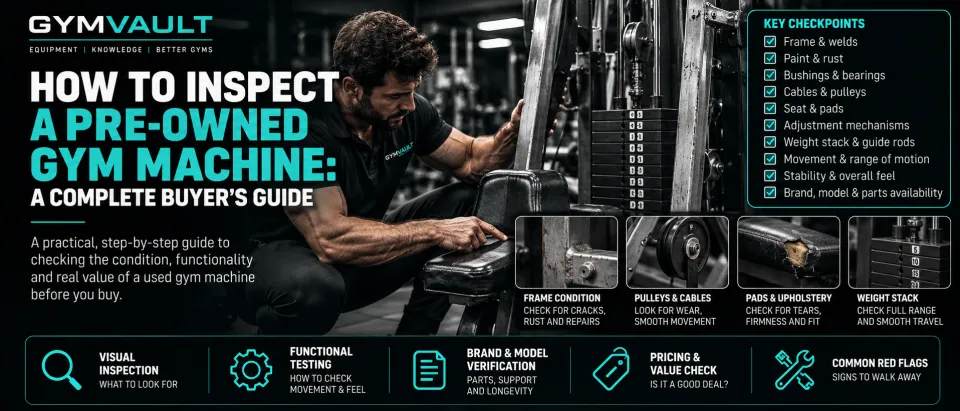
Buying pre-owned commercial equipment is one of the most effective ways to build a better gym for less money. It also rewards a careful eye. Two machines of the same model and age can be in very different condition, depending on where they were used, how they were maintained and how they were moved.
This guide follows the order we use when we inspect a machine. You can use it whether you are buying from us or from anyone else.
Start with the right expectations
Commercial strength equipment is designed for heavy, shared use. The international safety standard for stationary training equipment, ISO 20957-1, distinguishes equipment classified for commercial and institutional training areas from equipment classified for domestic use (ISO, 2024). In practice, the heavy frames of commercial machines rarely wear out. The parts that move do.
That shapes how you should inspect. The questions that matter most are whether the frame is sound, whether the wear parts are safe, and whether the worn parts can be replaced. Scuffed paint and a faded seat matter far less, and they should be reflected in the price rather than ruling a machine out.
Well-run facilities inspect their own equipment routinely. The American College of Sports Medicine's facility standards include sample maintenance schedules and checklists for exactly this reason (ACSM, 2019). A seller who can tell you how a machine was maintained is giving you useful information.
Before you travel: what to ask
- The exact brand, series and model. "A Life Fitness chest press" can mean several different machines.
- Photographs of specific parts. Ask for the whole machine from the front, side and rear, then close-ups of the upholstery, handles and adjustments, weight stack, cables and pulleys (or pivots and horns on plate-loaded machines), and the welds most likely to show wear.
- A short video of the machine moving through its full range, if possible.
- History. Where it was used, why it is being sold, and whether any parts have been replaced.
- What is included. Attachments, add-on weights, manuals, keys and any spare parts.
- For cardio machines, the recorded hours or distance if the console stores them, and the electrical specification.
- Size and weight, so you can check doors, lifts, stairs and floor loading at the delivery address.
The frame: the part you cannot easily fix
Start with the structure, because a structural fault is the one problem that a new seat cannot hide.
- Welds. Look closely at every joint, especially where uprights meet the base and where load-bearing arms attach. A hairline crack in the paint along a weld, or rust bleeding from a joint, can point to a crack in the metal beneath.
- Straightness. Sight along uprights, levers and rails. Anything bent has been overloaded, dropped or damaged in transport.
- Previous repairs. Fresh weld beads, grinding marks or patches of new paint in odd places deserve a question.
- Rust. Surface rust on a bolt head is cosmetic. Flaking or pitted rust on a structural tube is not.
- Feet and levelling. A machine that rocks on a flat floor may have a bent base.
Weight stacks, cables and pulleys
On selectorized machines and cable stations, these are the parts that work hardest.
- Weight-stack plates should be flat and uncracked. Lift the selector pin and check that it seats fully in every plate.
- Guide rods should be straight and clean, and the stack should rise and fall smoothly without catching.
- Cables must be inspected along their whole length and at both ends. Look for fraying, broken strands, kinks, flattened sections or bulges. Any damaged cable must be replaced before the machine is used. It is a routine part, but never a part to gamble on.
- Belts, where fitted instead of cables, should be free of cracks and fraying.
- Pulleys should spin freely and quietly, without wobble or cracked housings.
- Cams, on machines that have them, should have an undamaged surface, and the chain or belt that wraps the cam should be in good condition.
Pivots, sleds and safety stops
On plate-loaded machines, racks and benches:
- Pivot bearings should move silently with no side-to-side play. Grip the lever and try to rock it sideways.
- Weight horns and plate storage pegs should be straight and secure.
- Sled carriages and rails on leg presses and hack squats should travel smoothly without flat spots or grinding.
- Safety stops and catches must engage and release correctly at every position. On racks, check the J-hooks, safety arms and their liners.
- Adjustment ladders and pins should engage positively at every setting.
Adjustments and upholstery
Pull every pop-pin and move every adjustment through its full range. Each should lock positively without slipping. Range-of-motion limiters should hold.
Then look at the upholstery. Tears, collapsed foam and failed stitching are common on heavily used machines. They are cosmetic and comfort issues that a good upholsterer can fix, so treat them as a cost to factor in, not as a reason to reject an otherwise sound machine.
Free weights
Free weights are simple, and they should still be checked.
- Dumbbells. The heads should be tight, with no spin or rattle. Look for cracked or peeling coatings.
- Plates. Hub inserts should be secure and the plates free from cracks. Weigh a sample if accuracy matters to you.
- Barbells. Roll the bar on a flat floor to check that it is straight. Spin the sleeves and check the knurling for damage and rust.
Cardio equipment
Cardio machines have motors, electronics and more moving parts, so inspect them thoroughly.
- Check the recorded hours or distance where the console stores them.
- Run a treadmill through its full speed and incline range. Listen to the motor, watch the belt track, and look at the belt and deck for wear.
- On ellipticals, bikes and climbers, check the linkages, bearings, chains or belts, and the resistance system through its full range.
- Test every console function, including heart-rate sensors, the safety key and the emergency stop.
- Confirm the electrical specification against the supply where the machine will be installed. In India that is 230 V at 50 Hz, and some commercial treadmills need a dedicated circuit.
The test that matters most: move it under load
Load the machine lightly, then moderately, and move it slowly through its full range several times. Use your senses.
- Listen for grinding, clicking, squeaking or knocking.
- Feel for catches, sticking points, sudden drops or slack at either end of the movement.
- Watch the cable stay in its pulley grooves and the plates stay aligned on the guide rods.
A problem that appears at the same point in every repetition is almost always mechanical, and it is worth finding the cause before you buy.
Routine fixes and deal-breakers
| What you find | What it usually means | What to do |
|---|---|---|
| Torn or worn upholstery | Cosmetic and comfort | Factor re-upholstery into the price |
| Frayed or kinked cable | Safety-critical wear part | Must be replaced before use. Confirm parts are available |
| Noisy pulley | Worn bearing | Replace the pulley or bearing |
| Stack catches on the rods | Dirty, dry or slightly bent rods | Clean and lubricate. Replace a bent rod |
| Missing pin, knob or grip | Missing part | Replace, after confirming availability |
| Play in a main pivot | Worn bearings or bushings | Repair before use, after confirming parts are available |
| Cracked weight-stack plate | Damaged part | Replace the plate. Do not use the machine until you do |
| Cracked weld or bent frame | Structural damage | Walk away, unless a qualified professional assesses and repairs it properly |
Get it in writing
Whoever you buy from, ask for the condition, any known imperfections, everything included, the delivery and installation scope, and the after-sales terms for that specific unit in writing, together with photographs of the actual machine.
This is how we work too. Every unit we hold is inspected by hand against a written checklist, graded, and photographed, including its flaws. When we source a model for you, we send photographs of that exact machine before you commit. You can read our full checklist on our quality process page.


References
- American College of Sports Medicine, Sanders M. ACSM's Health/Fitness Facility Standards and Guidelines. 5th ed. Human Kinetics; 2019. ISBN 9781492567189. humankinetics.com
- International Organization for Standardization. ISO 20957-1:2024 Stationary training equipment — Part 1: General safety requirements and test methods. Geneva: ISO; 2024. iso.org
Further reading
- Refurbished, serviced or restored? Condition grades explained
- What "commercial grade" really means
- Our quality process
- Request a quotation
This guide reflects GYMVAULT's own inspection practice. Always confirm the condition, specifications and terms of any specific machine before you buy it.


