Few gym debates are as old or as heated. One side argues that free weights are "functional" and that machines are for people who are afraid of real training. The other side argues that machines isolate muscles better and that free weights add risk for no benefit. Both sides usually argue from experience. This article looks at what controlled research has found.
What direct comparisons show
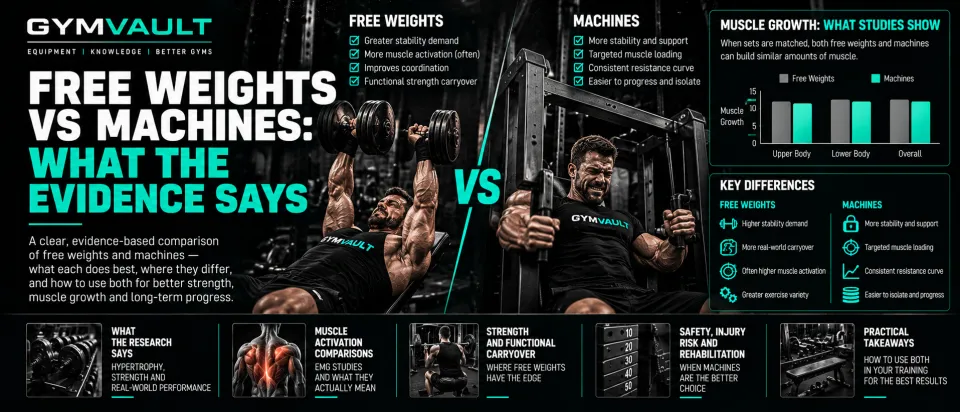
The clearest summary comes from a 2023 meta-analysis that pooled 13 studies directly comparing free-weight and machine training for at least six weeks in adults, with more than 1,000 participants in total (Haugen et al., 2023). The findings were consistent and fairly simple:
- Muscle growth: no difference between free weights and machines.
- Overall strength: no difference when free-weight strength was compared directly with machine strength, for either dynamic or isometric tests.
- Jump performance: no difference.
- Specificity: people who trained with free weights improved more on free-weight strength tests, and people who trained on machines tended to improve more on machine tests.
The authors concluded that strength changes are specific to the training method and that the choice between free weights and machines comes down to individual preferences and goals.
A well-controlled individual study shows the same pattern. Forty-six young men and women trained for eight weeks with either free weights or machines, using the same sets and repetition ranges. Muscle thickness of the biceps and quadriceps increased similarly in both groups. Free-weight bench press, squat and Smith machine squat strength increased similarly too, by 11% to 19%. The only group difference in strength was on the machine bench press, which improved more in the machine group, 13.9% compared with 8.6% (Schwanbeck et al., 2020).
That study also measured hormones. Men who trained with free weights had larger short-term rises in free testosterone during sessions, but it made no difference to how much muscle or strength they gained. This fits other research showing that short-term hormone rises after training do not predict long-term results (Morton et al., 2016).
The 2026 American College of Sports Medicine position stand, an overview of 137 systematic reviews, reached the same broad conclusion: equipment type did not consistently affect training outcomes (Currier et al., 2026).
Specificity: you get better at what you practise
The most reliable difference between free weights and machines is not about muscle at all. It is about skill. Strength depends partly on how well your nervous system coordinates a particular movement, and that coordination is specific to the movement you practise.
If your goal is a bigger squat, deadlift or bench press, for sport, powerlifting or the satisfaction of it, you need to practise those lifts with a barbell. If your goal is muscle, health and general strength, the equipment matters much less than effort, volume and consistency.
Where free weights shine
- Skill and coordination. Balancing and controlling a free load trains coordination that transfers to other free movements.
- Versatility. A rack, a bench, a barbell, plates and a set of dumbbells support hundreds of exercises in a small footprint.
- Natural movement paths. Dumbbells let each arm find its own path, and a barbell lets lifters adjust their technique to their build.
- Durability and value. Well-made bars, plates and dumbbells last for decades with little maintenance, which makes them excellent pre-owned purchases.
The trade-off is technique and safety. Heavy free-weight lifts need coaching, and sets close to failure need a spotter or correctly set safety arms.
Where machines shine
- Easy to learn. A new member can train productively on day one with a short orientation.
- Safe close to failure. A machine lets a set end safely at any point, without a spotter. This matters in unsupervised facilities and for people training alone.
- Isolation and targeting. Machines can load one muscle hard while others rest, which is useful for weak points, for working around an injury with professional guidance, and for loading the lengthened position, where recent research suggests extra benefit for growth (see How strength machines load your muscles).
- Fast, consistent loading. Changing weight takes seconds, and recorded settings make progress easy to track.
The trade-off is cost and space. Each machine usually does one or two exercises, and quality machines are expensive new, which is one reason the pre-owned market for them is so active.


Choosing the mix for a gym
Because outcomes are similar, the right mix depends on the facility and its members rather than on any idea that one type of equipment is superior.
| Facility | Typical members | Suggested emphasis |
|---|---|---|
| Hotel or residential gym | Mixed experience, mostly unsupervised | Mainly selectorized machines and a cable station, with dumbbells and an adjustable bench |
| Corporate gym | Short sessions, mixed ages | Machines for quick, safe circuits, plus dumbbells and a functional trainer |
| General commercial gym | Broad membership | Balanced zones: machines, plate-loaded equipment, racks, benches and a full dumbbell run |
| Strength or bodybuilding gym | Experienced lifters | Racks, platforms, bars and plates, plus heavy plate-loaded machines |
| Personal-training studio | Coached sessions | Free weights and cables for versatility, with a few key machines |
These are starting points. A facility's floor area, supervision, budget and members' goals should shape the final plan, which we cover in Building a commercial gym on a defined budget.
The bottom line
For building muscle and general strength, free weights and machines are close to interchangeable. Specificity, skill, safety and preference are what separate them. Most people do best with both: free weights to build skill and versatility, and machines to train hard, safely and precisely.
References
- Currier BS, D'Souza AC, Singh MAF, et al. American College of Sports Medicine position stand. Resistance training prescription for muscle function, hypertrophy, and physical performance in healthy adults: an overview of reviews. Med Sci Sports Exerc. 2026;58(4):851–872. doi:10.1249/MSS.0000000000003897
- Haugen ME, Vårvik FT, Larsen S, Haugen AS, van den Tillaar R, Bjørnsen T. Effect of free-weight vs. machine-based strength training on maximal strength, hypertrophy and jump performance: a systematic review and meta-analysis. BMC Sports Sci Med Rehabil. 2023;15(1):103. doi:10.1186/s13102-023-00713-4
- Morton RW, Oikawa SY, Wavell CG, et al. Neither load nor systemic hormones determine resistance training-mediated hypertrophy or strength gains in resistance-trained young men. J Appl Physiol. 2016;121(1):129–138. doi:10.1152/japplphysiol.00154.2016
- Schwanbeck SR, Cornish SM, Barss T, Chilibeck PD. Effects of training with free weights versus machines on muscle mass, strength, free testosterone, and free cortisol levels. J Strength Cond Res. 2020;34(7):1851–1859. doi:10.1519/JSC.0000000000003349
Further reading
- How strength machines load your muscles
- Resistance curves and why the cam matters
- Browse plates and barbells
This article is general information about training and equipment. It is not medical advice. Speak to a qualified professional before starting a new exercise programme, particularly if you have an injury, a health condition or have been inactive.