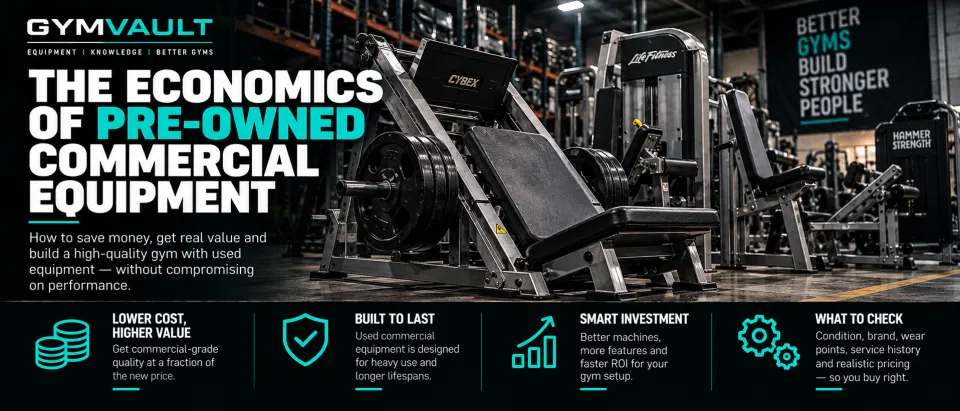
"How much does it cost?" is the first question every buyer asks, and the least complete. A machine that is cheaper to buy can be more expensive to own if it breaks down often, needs parts that take weeks to arrive, or is worth nothing when you replace it. This article sets out a simple framework for comparing new and pre-owned equipment, and is candid about when each makes sense.
Think in total cost of ownership
The total cost of owning a machine over the period you will use it can be written as a simple sum:
Total cost of ownership = purchase price + delivery and installation + maintenance and parts + cost of downtime − resale value when you replace it
Each term deserves attention.
- Purchase price. The number on the quotation. Make sure it includes the same things for every option, such as attachments, add-on weights and refurbishment work.
- Delivery and installation. Heavy commercial machines may need specialist handling, stair climbing or partial disassembly. Get these costs itemised.
- Maintenance and parts. Every machine needs routine maintenance, and the sample maintenance schedules in the ACSM's facility standards are a useful basis for estimating it (ACSM, 2019). A pre-owned machine may need wear parts sooner, unless they have already been renewed during refurbishment.
- Cost of downtime. A broken machine has a cost even when the repair is cheap. In a commercial gym it is an unhappy member and a queue at the next station. Parts lead times matter as much as parts prices.
- Resale value. What the machine will be worth when you refit. Well-known commercial lines in good condition tend to keep a market. Obscure or poorly maintained equipment may not.
Accountants describe the same idea in their own terms. International accounting standards define depreciation as the systematic allocation of an asset's cost, less its residual value, over its useful life (IFRS Foundation, IAS 16). Whatever your accounting treatment, the economic logic is the same: what matters is how much value you consume while you use the machine, not only what you pay at the start.
Why pre-owned commercial equipment can deliver strong value
Commercial strength equipment has an unusual property. Its most expensive component, a heavy welded steel frame, has a very long working life, while the parts that wear out (cables, pulleys, bearings, grips and upholstery) are designed to be replaced. When a gym refits, it often replaces machines that are structurally sound because it wants a new look, a different layout or the latest model, not because the machines have reached the end of their lives.
Durable equipment also tends to lose resale value fastest early in its life. Where that is true, a buyer of a well-maintained pre-owned machine avoids the steepest part of the decline, and pays mainly for the remaining useful life, plus the cost of any refurbishment.
A worked example
The numbers below are invented for illustration. They are index numbers, not prices, and real figures vary widely by model, age, condition and location. The method is the point.
Imagine a strength machine whose new price is 100. You expect to use it for the same number of years whichever route you take.
| Cost item | Buy new | Buy pre-owned, refurbished |
|---|---|---|
| Purchase price | 100 | 60 |
| Delivery and installation | 5 | 5 |
| Maintenance and parts over the period | 6 | 10 |
| Allowance for downtime | 2 | 4 |
| Resale value at the end | −35 | −25 |
| Total cost of ownership | 78 | 54 |
In this illustration the pre-owned machine costs less to own, even after higher maintenance, more downtime and a lower resale value. But change the assumptions and the answer moves. If the pre-owned machine needed major parts that were hard to obtain, or if its resale value were close to zero, the gap would narrow quickly. Run the same table with real quotations and realistic estimates before you decide.


The hidden costs that change the answer
- Parts availability. Before buying any machine, new or pre-owned, ask whether parts are available and how long they take to arrive.
- Refurbishment quality. "Refurbished" can mean very different things. Ask exactly what was done. See Refurbished, serviced or restored? Condition grades explained.
- Consistency. A floor of mixed brands and generations can look less coherent and be harder for members to learn. Buying matched lines, or consistent colours and upholstery, reduces that cost.
- Electrical and building work. Commercial cardio may need dedicated circuits, and heavy equipment may need floor protection or reinforcement. These costs apply to new and pre-owned alike, but they are easy to forget.
- Your own time. Comparing many small sellers, arranging transport and supervising installation takes time. A single itemised quotation for the whole job can be worth a great deal.
When buying new is the better decision
Pre-owned is not always the right answer. New equipment usually makes more sense when:
- you need a manufacturer's warranty or service contract as a condition of financing, insurance or procurement rules;
- you want current models, for example the latest connected cardio consoles, or a finish and colour scheme that must match exactly;
- the equipment is rarely available pre-owned, or the pre-owned discount is small;
- your organisation's procurement policy requires new equipment.
Many of the best-value facilities use both: pre-owned commercial equipment where robustness matters most, such as plate-loaded and selectorized strength machines, racks and free weights, and new equipment where warranties or specific models matter.
The other half of the economics: selling
Resale value works in both directions. A gym that is refitting can recover part of the cost of its new floor by selling the equipment it is replacing, provided that equipment has been maintained and its history recorded. If you are planning an upgrade, it is worth asking for an offer on your current equipment before you finalise the budget for the new floor. You can tell us about equipment you want to sell.
A value checklist for any quotation
- Is the machine identified exactly, by brand, series and model?
- Is the refurbishment scope itemised?
- Are delivery and installation priced, with access confirmed?
- Are the after-sales terms for each unit written into the quotation?
- Are parts available, and how quickly?
- Have you estimated resale value at the end of your planned period of use?
References
- IFRS Foundation. IAS 16 Property, Plant and Equipment. Issued standard. ifrs.org
- American College of Sports Medicine, Sanders M. ACSM's Health/Fitness Facility Standards and Guidelines. 5th ed. Human Kinetics; 2019. ISBN 9781492567189. humankinetics.com
Further reading
- Building a commercial gym on a defined budget
- What "commercial grade" really means
- Commercial solutions
- Sell your equipment
This article is general information for planning purposes. It is not financial, tax or legal advice. Figures used in examples are illustrative, not quotes or market prices.