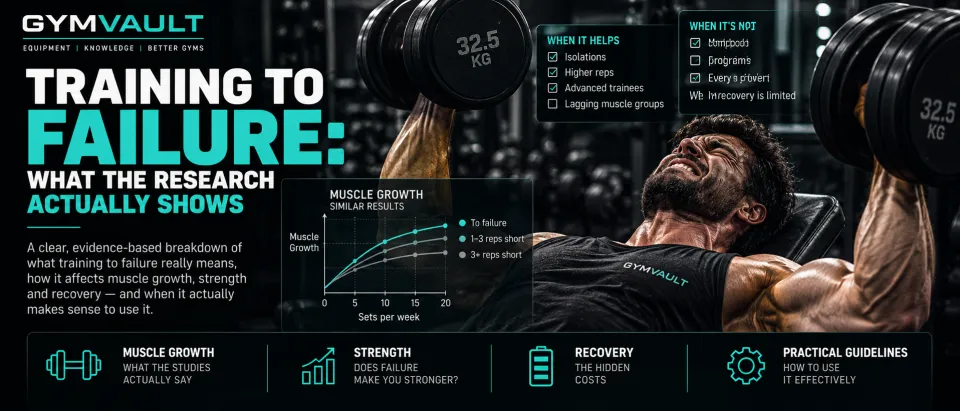
Few training questions generate as much heat as this one. One camp says the last, grinding repetition is where the results are. The other says failure is an unnecessary risk that ruins recovery. Both camps can point to studies, and both often talk past each other because they are not using the word failure in the same way.
This article starts with definitions, then looks at what the systematic reviews and meta-analyses actually found, and ends with practical rules for applying them.
First, define failure
Researchers have pointed out that training studies use the terms for the end of a set loosely, which makes results hard to compare and easy to misread (Steele et al., 2017). It helps to separate three ideas:
- Momentary muscular failure. You attempt another repetition with good form and cannot complete it despite maximal effort.
- A self-chosen or fixed endpoint. You stop at a planned number of repetitions, or when you believe you could not do another.
- Repetitions in reserve (RIR). You stop a known distance from failure: one in reserve, two in reserve and so on.
The RIR idea has become a practical tool. Zourdos and colleagues (2016) introduced a rating scale in which an effort rating of 10 means no repetitions left, 9 means one left, and so on. In a later eight-week trial, choosing loads by this kind of rating worked as well as prescribing fixed percentages of one-repetition maximum, with a possible small advantage for strength (Helms et al., 2018).
What the meta-analyses found
Strength and size, failure versus non-failure
A 2022 meta-analysis of 15 studies found no significant difference between training to failure and non-failure for either strength or muscle growth overall (Grgic et al., 2022). Two subgroup results are worth knowing. When the groups did not do the same volume, non-failure training produced better strength gains. In resistance-trained participants, failure training produced a small advantage for muscle growth.
A second meta-analysis of 13 studies came to a similar place by a slightly different route. It found no difference for maximal strength overall, an advantage for non-failure training on strength and power when volumes were not equalised, and an advantage for failure on muscle growth that disappeared when volumes were equalised (Vieira et al., 2021). In other words, some of the apparent benefit of failure comes from the extra work it adds, not from failure itself.
How close is close enough?
A 2023 meta-analysis focused specifically on muscle growth. Across all definitions of failure, it found a trivial advantage for ending sets at failure. When the analysis was limited to genuine momentary muscular failure, there was no advantage over non-failure training. The authors suggested the relationship between proximity to failure and growth may not be a straight line (Refalo et al., 2023).
A 2024 series of meta-regressions took the next step and estimated repetitions in reserve for every training group in the literature. Muscle growth increased as sets ended closer to failure. Strength gains were similar across a wide range of effort levels. The authors cautioned that the analysis was exploratory, because RIR had to be estimated from study descriptions (Robinson et al., 2024).
What the newest position stand says
The 2026 American College of Sports Medicine position stand reviewed 137 systematic reviews. It concluded that training to momentary muscle fatigue did not consistently change training outcomes (Currier et al., 2026).
Fatigue within a set
Another way to study effort is to measure bar speed. As a set progresses, each repetition slows down, and the percentage of speed lost tells you roughly how hard the set was.
In one trial, young men squatted for eight weeks, either stopping each set when speed had fallen by 20% or continuing to a 40% loss. Both groups gained similar squat strength, and the 20% group improved jump performance more while doing 40% fewer repetitions. The 40% group, however, gained more muscle in two of the quadriceps muscles, and it lost some of its fastest muscle fibre type (Pareja-Blanco et al., 2017).
That one study captures the trade-off neatly. Pushing deeper into a set favoured size. Stopping earlier favoured speed and efficiency.
The cost of failure: recovery
Effort is not free. In a study of trained men, sets taken to failure on the bench press and squat caused larger short-term drops in performance and slower recovery of neuromuscular function, up to 24 to 48 hours, than protocols that stopped at half the possible repetitions, even when total volume was the same (Morán-Navarro et al., 2017).
This matters most when you train the same muscles or lifts again within a day or two, or when you have sport or work that needs you fresh.
Putting it together
The evidence supports a middle path. In practice:
- Most working sets should end within about three repetitions of failure. Sets that stop very far from failure are less effective for muscle growth.
- For muscle growth, finish some sets at or very near failure. The last set of an exercise is the natural place, especially on single-joint movements.
- For strength, stay further away. Two to four repetitions in reserve keeps bar speed and technique high on heavy compound lifts.
- Choose where you go to failure. It is safest on machines, where you can stop at any point, and in a power rack with the safety bars set correctly. Avoid it on heavy free-weight lifts such as the bench press or squat without a spotter or safeties.
- Calibrate yourself. Estimating repetitions in reserve takes practice. Taking an occasional set to failure on a safe exercise shows you how accurate your guesses are.


A note for gyms
How members train shapes what a gym needs. Members who train hard without a partner benefit from racks with reliable safety arms, Smith machines and selectorized or plate-loaded machines that let a set end safely wherever it ends. When you buy pre-owned, check the parts that make that possible: safety catches, J-hooks, spotter arms, and the start and stop positions of each machine. We cover this in How to inspect a pre-owned gym machine.
References
- Currier BS, D'Souza AC, Singh MAF, et al. American College of Sports Medicine position stand. Resistance training prescription for muscle function, hypertrophy, and physical performance in healthy adults: an overview of reviews. Med Sci Sports Exerc. 2026;58(4):851–872. doi:10.1249/MSS.0000000000003897
- Grgic J, Schoenfeld BJ, Orazem J, Sabol F. Effects of resistance training performed to repetition failure or non-failure on muscular strength and hypertrophy: a systematic review and meta-analysis. J Sport Health Sci. 2022;11(2):202–211. doi:10.1016/j.jshs.2021.01.007
- Helms ER, Byrnes RK, Cooke DM, et al. RPE vs. percentage 1RM loading in periodized programs matched for sets and repetitions. Front Physiol. 2018;9:247. doi:10.3389/fphys.2018.00247
- Morán-Navarro R, Pérez CE, Mora-Rodríguez R, et al. Time course of recovery following resistance training leading or not to failure. Eur J Appl Physiol. 2017;117(12):2387–2399. doi:10.1007/s00421-017-3725-7
- Pareja-Blanco F, Rodríguez-Rosell D, Sánchez-Medina L, et al. Effects of velocity loss during resistance training on athletic performance, strength gains and muscle adaptations. Scand J Med Sci Sports. 2017;27(7):724–735. doi:10.1111/sms.12678
- Refalo MC, Helms ER, Trexler ET, Hamilton DL, Fyfe JJ. Influence of resistance training proximity-to-failure on skeletal muscle hypertrophy: a systematic review with meta-analysis. Sports Med. 2023;53(3):649–665. doi:10.1007/s40279-022-01784-y
- Robinson ZP, Pelland JC, Remmert JF, et al. Exploring the dose–response relationship between estimated resistance training proximity to failure, strength gain, and muscle hypertrophy: a series of meta-regressions. Sports Med. 2024;54(9):2209–2231. doi:10.1007/s40279-024-02069-2
- Steele J, Fisher J, Giessing J, Gentil P. Clarity in reporting terminology and definitions of set endpoints in resistance training. Muscle Nerve. 2017;56(3):368–374. doi:10.1002/mus.25557
- Vieira AF, Umpierre D, Teodoro JL, et al. Effects of resistance training performed to failure or not to failure on muscle strength, hypertrophy, and power output: a systematic review with meta-analysis. J Strength Cond Res. 2021;35(4):1165–1175. doi:10.1519/JSC.0000000000003936
- Zourdos MC, Klemp A, Dolan C, et al. Novel resistance training-specific rating of perceived exertion scale measuring repetitions in reserve. J Strength Cond Res. 2016;30(1):267–275. doi:10.1519/JSC.0000000000001049
Further reading
- Mechanical tension and progressive overload, explained
- Dorian Yates and the case for fewer, harder sets
- Browse benches and racks
This article is general information about training and equipment. It is not medical advice. Speak to a qualified professional before starting a new exercise programme, particularly if you have an injury, a health condition or have been inactive.


