Heavy Duty divides opinion. To its followers, it is the logical way to build muscle: one all-out set, then enough rest to grow. To its critics, it is a recipe for doing too little. Both sides tend to argue about a version of Mentzer that never quite existed, because his prescription changed a great deal over his life.
This article sets out what he actually recommended, when, and what the research says about it.
Who was Mike Mentzer?
Michael John Mentzer was born on 15 November 1951 in Germantown, Pennsylvania, and grew up in nearby Ephrata (Mentzer estate, n.d.; McGough, 1995). His competitive record, as reported by Peter McGough, a former editor-in-chief of FLEX, and by Mentzer's estate:
- 1976: won the Mr. America.
- 1978: won the Mr. Universe in Acapulco with what McGough calls "the first perfect score recorded in IFBB history". The estate puts the score at 300 points.
- 1979: won the heavyweight class of the Mr. Olympia but lost the overall title to Frank Zane.
- 1980: placed fifth at the Mr. Olympia in Sydney, and did not compete again.
He then built a second career as a writer and personal trainer. His best-known books are Heavy Duty (self-published, 1993), Heavy Duty II: Mind and Body (1996) and High-Intensity Training the Mike Mentzer Way, written with John Little and released by McGraw-Hill at the end of 2002. Mentzer died on 10 June 2001, aged 49. His brother Ray, also a bodybuilder, died two days later (McGough, 1995; Mentzer estate, n.d.).
The theory: intensity, brevity, infrequency
Mentzer built on the ideas of Arthur Jones, the inventor of Nautilus machines. In his last interview he said that when he began training clients he used "Arthur Jones' basic theory of high-intensity training", and that he refined it over the following years (Iron Man, 2001). His version rested on three ideas.
- Intensity. A set should continue to momentary muscular failure, the point at which another full repetition is impossible.
- Brevity. Once a hard set has stimulated growth, more sets only add to the recovery bill. "You shouldn't do more than one set to stimulate growth," he said in 2001.
- Infrequency. The body has to recover from a workout before it can grow, so sessions should be spread out. Mentzer believed overtraining, not undertraining, was the common mistake.
The routine kept changing
There is no single "Mike Mentzer workout". The sources describe a prescription that became steadily briefer and less frequent:
| Period | What he prescribed | Source |
|---|---|---|
| Late 1970s | Three workouts a week, three to five sets per body part | McGough (1995) |
| About 1990 | New clients started on 12 to 20 sets, three times a week, then cut back | Mentzer, in Iron Man (2001) |
| 1995 | The "Ideal Routine": three rotating workouts about 72 hours apart, four or five working sets each | Little (2026), from a 1995 consultation |
| Mid-1990s | The "Consolidated Routine": four exercises divided into two workouts, most often with four to seven days of rest between sessions | Shawcross (2026) |
| 2001 | Two to four sets per workout, once every four to seven days, sometimes 10 or even 14 | Mentzer, in Iron Man (2001) |
His influence reached the next generation directly. Dorian Yates has described how Mentzer suggested he try cutting back to one set to failure, which Yates says he began around 1991 or 1992 (Huberman Lab, 2026). We look at Yates's own method in Dorian Yates and the case for fewer, harder sets.
The 1995 Ideal Routine
The best-documented version is the "Ideal Routine" that Mentzer prescribed in a 1995 telephone consultation, as recorded by John Little (2026):
| Workout | Exercises, one working set each |
|---|---|
| 1. Chest and back | Dumbbell flyes or pec deck, followed immediately by close-grip incline presses; close-grip palms-up pulldowns; rows; shrugs |
| 2. Shoulders and arms | Lateral raises; rear-deltoid work; straight-bar curls; triceps pressdowns; dips |
| 3. Legs | Leg extensions, followed immediately by leg presses; leg curls; standing calf raises |
Each set was taken to momentary muscular failure, generally with a weight that allowed about six to ten strict repetitions. Workouts came round roughly every 72 hours, and Mentzer advised against training more often than every 48 hours. The pairs of exercises done back to back are "pre-exhaust": an isolation exercise tires a muscle just before a compound exercise for the same muscle.
The routine leans heavily on machines: a pec deck, pulldowns, pressdowns, a leg extension, a leg press and a leg curl. That is no accident. A machine lets you take a set to failure safely without a spotter, and an isolation machine is the natural first half of a pre-exhaust pair.


What the research says
Is one set enough?
Single sets work. Several sets usually work better. In a meta-regression of 14 studies, two to three sets per exercise were associated with 46% greater strength gains than one set (Krieger, 2009), and a companion analysis found that multiple sets were associated with 40% larger effects on muscle growth (Krieger, 2010). For strength in trained men, a single hard set two to three times a week produced gains that a systematic review described as "suboptimal, yet significant" (Androulakis-Korakakis et al., 2020).
Later work points the same way. In resistance-trained men who did one, three or five sets per exercise for eight weeks, strength gains were similar, but muscle growth was greater with the higher volumes at most of the sites measured (Schoenfeld et al., 2019). A 2026 analysis of 67 studies found that gains in muscle size and strength both rise with weekly volume, with diminishing returns that set in much faster for strength than for size (Pelland et al., 2026). The 2026 American College of Sports Medicine position stand concluded that muscle growth is enhanced by at least ten sets per muscle per week (Currier et al., 2026).
Set against that, the 1995 Ideal Routine gives most muscles one or two direct working sets every nine days or so. That is enough to build strength and some muscle, but well below the volumes associated with the best gains.
How often should you train?
When weekly volume is matched, training a muscle once, twice or three times a week produces similar growth (Schoenfeld, Grgic and Krieger, 2019), although more frequent practice does help strength (Pelland et al., 2026). The problem with Mentzer's later schedules is not the long gap in itself. It is that long gaps, combined with one set per exercise, leave each muscle with very little weekly work.
Recovery is the usual justification. Sets taken to failure are more fatiguing: in one study of trained men, neuromuscular performance took up to 24 to 48 hours to recover after training to failure, longer than after equal work that stopped short (Morán-Navarro et al., 2017). That is a real cost, but it is measured in a day or two, not the one to two weeks Mentzer came to recommend.
Does training to failure matter?
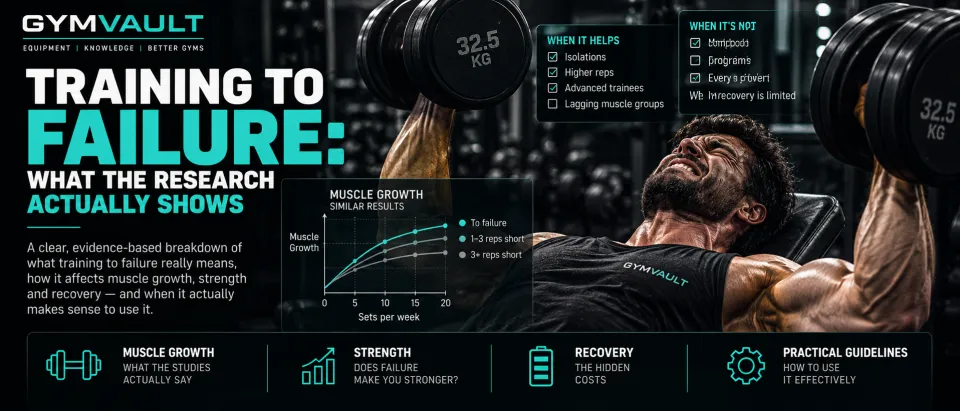
This is where Mentzer was closest to the evidence. Meta-regression evidence suggests that muscle growth increases as sets end closer to failure (Robinson et al., 2024). Reaching failure itself, though, has not been shown to beat stopping just short of it for muscle growth (Refalo et al., 2023). Effort matters, but the last grinding repetition is optional, and so are the forced repetitions and negatives that take a set beyond failure.
What about pre-exhaust?
Pre-exhaust is a type of superset. A 2025 meta-analysis found that supersets of biomechanically similar exercises reduced the total load lifted compared with traditional sets. Supersets in general saved time without compromising long-term gains in strength or muscle, although only three of the 19 studies measured long-term outcomes (Zhang et al., 2025). Pre-exhaust is a reasonable way to save time, but the superset research gives no sign that it builds more muscle.
Does Heavy Duty work for natural lifters?
Brief, very hard training does build strength and muscle, and Heavy Duty is extremely time-efficient. For most people, though, the research suggests more muscle will come from more weekly sets than Mentzer's later routines allowed, spread across one to three sessions per muscle each week.
The evidence comes mostly from young, untrained or recreationally trained adults, and individual responses vary. Some people do recover slowly, and a short programme they stick to beats a long one they abandon.
| Mentzer's Ideal Routine (1995) | A research-informed version | |
|---|---|---|
| Sets per exercise | One, to failure | One or two, ending at or close to failure |
| Schedule | Three rotating workouts, about 72 hours apart | Each muscle trained once or twice a week |
| Hard sets per muscle per week | About one or two | At least six to ten for the muscles you most want to grow |
| Techniques | Pre-exhaust | Optional; use them on machines, where a set can end safely |
| Progression | Add weight once you beat the repetition target | The same |
The bottom line
Mentzer was right that effort drives results, that hard sets are costly, and that many people waste time on sets that do little. He went further than the evidence when he argued that one set and long rests are optimal for everyone. Take his intensity, keep a record of every working set, and give your muscles more weekly work than his later routines did.
References
- Androulakis-Korakakis P, Fisher JP, Steele J. The minimum effective training dose required to increase 1RM strength in resistance-trained men: a systematic review and meta-analysis. Sports Med. 2020;50(4):751–765. doi:10.1007/s40279-019-01236-0
- Currier BS, D'Souza AC, Singh MAF, et al. American College of Sports Medicine position stand. Resistance training prescription for muscle function, hypertrophy, and physical performance in healthy adults: an overview of reviews. Med Sci Sports Exerc. 2026;58(4):851–872. doi:10.1249/MSS.0000000000003897
- Huberman Lab. Build muscle & strength & forge your life path, with Dorian Yates. 19 January 2026. hubermanlab.com
- Iron Man. Mike Mentzer's last interview. 1 October 2001. ironmanmagazine.com
- Krieger JW. Single versus multiple sets of resistance exercise: a meta-regression. J Strength Cond Res. 2009;23(6):1890–1901. doi:10.1519/JSC.0b013e3181b370be
- Krieger JW. Single vs. multiple sets of resistance exercise for muscle hypertrophy: a meta-analysis. J Strength Cond Res. 2010;24(4):1150–1159. doi:10.1519/JSC.0b013e3181d4d436
- Little J. Mike Mentzer's Ideal Routine for natural bodybuilders: his 1995 Heavy Duty blueprint. mikementzer.org. 24 August 2026. mikementzer.org
- McGough P. The Mike Mentzer story. FLEX, February 1995; reprinted by The Barbell, 15 August 2024. thebarbell.com
- Mentzer estate. Complete life timeline. mikementzer.org. Accessed October 2026. mikementzer.org
- Morán-Navarro R, Pérez CE, Mora-Rodríguez R, et al. Time course of recovery following resistance training leading or not to failure. Eur J Appl Physiol. 2017;117(12):2387–2399. doi:10.1007/s00421-017-3725-7
- Pelland JC, Remmert JF, Robinson ZP, Hinson SR, Zourdos MC. The resistance training dose response: meta-regressions exploring the effects of weekly volume and frequency on muscle hypertrophy and strength gains. Sports Med. 2026;56(2):481–505. doi:10.1007/s40279-025-02344-w
- Refalo MC, Helms ER, Trexler ET, Hamilton DL, Fyfe JJ. Influence of resistance training proximity-to-failure on skeletal muscle hypertrophy: a systematic review with meta-analysis. Sports Med. 2023;53(3):649–665. doi:10.1007/s40279-022-01784-y
- Robinson ZP, Pelland JC, Remmert JF, et al. Exploring the dose–response relationship between estimated resistance training proximity to failure, strength gain, and muscle hypertrophy: a series of meta-regressions. Sports Med. 2024;54(9):2209–2231. doi:10.1007/s40279-024-02069-2
- Schoenfeld BJ, Contreras B, Krieger J, et al. Resistance training volume enhances muscle hypertrophy but not strength in trained men. Med Sci Sports Exerc. 2019;51(1):94–103. doi:10.1249/MSS.0000000000001764
- Schoenfeld BJ, Grgic J, Krieger J. How many times per week should a muscle be trained to maximize muscle hypertrophy? A systematic review and meta-analysis of studies examining the effects of resistance training frequency. J Sports Sci. 2019;37(11):1286–1295. doi:10.1080/02640414.2018.1555906
- Shawcross S. Mike Mentzer's Consolidated Routine: the four-exercise Heavy Duty blueprint. mikementzer.org. 22 May 2026. mikementzer.org
- Zhang X, Weakley J, Li H, et al. Superset versus traditional resistance training prescriptions: a systematic review and meta-analysis exploring acute and chronic effects on mechanical, metabolic, and perceptual variables. Sports Med. 2025;55(4):953–975. doi:10.1007/s40279-025-02176-8
Further reading
- Arthur Jones, Nautilus and the birth of high-intensity training
- Dorian Yates and the case for fewer, harder sets
- Training to failure: what the research actually shows
- Hypertrophy training: what the research says
- Browse selectorized machines
This article is general information about training and equipment. It is not medical advice. Speak to a qualified professional before starting a new exercise programme, particularly if you have an injury, a health condition or have been inactive.