Search for "hypertrophy training" and you will find confident rules: eight to twelve repetitions, sixty seconds' rest, a "pump", a special split. Most of these rules are older than the research that has since tested them. This guide works through the main training variables one at a time, says what controlled studies and meta-analyses have found, and ends with a sample week.
What hypertrophy training is
Hypertrophy is an increase in the size of a muscle. The main signal for it appears to be mechanical: the tension muscle fibres experience when they work hard against a load. A 2019 review of the stimuli and sensors behind growth concluded that mechanical signals are the prime candidates, that muscle damage is probably not essential, and that the case for metabolites as a stimulus rests on indirect evidence (Wackerhage et al., 2019). We explain the idea in Mechanical tension and progressive overload.
Strength and hypertrophy overlap, but they are not the same goal. Bigger muscles can produce more force, but maximal strength also depends on skill with the specific lift and on practice with heavy loads. That is why several of the findings below differ for strength and for size.
1. Volume: how many sets per muscle per week?
Volume, counted as hard sets per muscle per week, is the best-supported dial for growth.
- A meta-analysis of 15 studies found a dose–response relationship between weekly sets and muscle growth, with each additional set associated with a small further increase (Schoenfeld et al., 2017).
- A 2026 analysis of 67 studies and 2,058 participants confirmed that gains in muscle size and strength both rise with weekly volume, with diminishing returns that set in much faster for strength than for size. It also found that results were best predicted when a set that trains a muscle indirectly, such as the triceps in a bench press, counted as half a set (Pelland et al., 2026).
- The 2026 American College of Sports Medicine position stand concluded that muscle growth is enhanced by at least ten sets per muscle per week (Currier et al., 2026).
- There is a ceiling. In trained young men, a review found no difference between moderate (12 to 20 weekly sets) and high (more than 20) volumes for the quadriceps or biceps, although high volume did favour the triceps (Baz-Valle et al., 2022).
In practice: about ten hard sets per muscle per week is a sensible starting point. Add sets, one or two at a time, for muscles you want to prioritise, as long as you can recover and keep progressing. We go deeper in Volume, frequency and recovery.
2. Load and reps: what rep range is best for hypertrophy?
There is no single hypertrophy rep range.
- A meta-analysis that included only studies where every set went to momentary failure found that low loads (60% of one-repetition maximum or less) and high loads (above 60%) produced similar muscle growth, while heavy loads produced greater gains in maximal strength (Schoenfeld et al., 2017).
- A 2021 network meta-analysis of 28 studies reached the same conclusion: growth appeared independent of load when sets were taken to failure, and strength gains were greater with heavier loads (Lopez et al., 2021).
- Researchers have therefore proposed replacing the old idea that particular rep ranges are uniquely "for" strength, size or endurance with a wider view in which muscle can be built across many loading zones (Schoenfeld et al., 2021).
In practice: light loads work, but they need many repetitions to get close to failure, which is slow and uncomfortable. Very heavy loads build strength well but make each set more demanding to recover from. Our suggestion is to do most sets with weights you can lift for roughly 6 to 15 repetitions, with some heavier and some lighter work for variety, and heavier work if maximal strength matters to you.
3. Effort: how close to failure?
How hard a set is matters as much as how many sets you do.
- A series of meta-regressions found that muscle growth increases as sets end closer to failure, while strength gains are similar across a wide range of effort levels (Robinson et al., 2024).
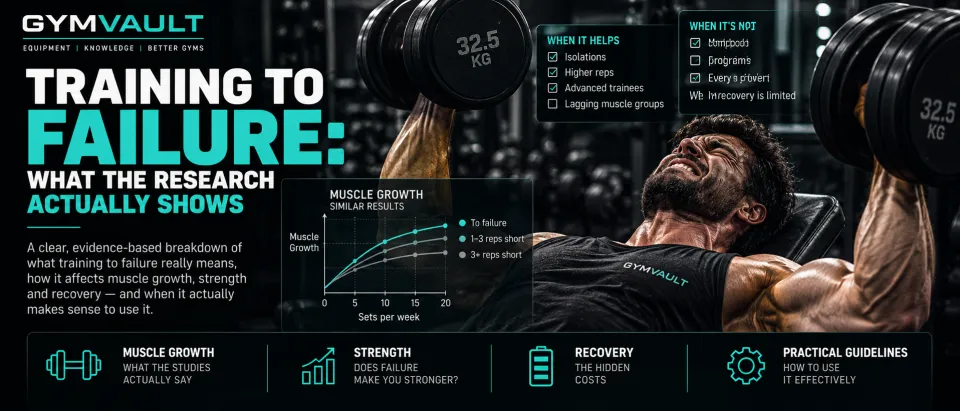
- Going all the way to momentary failure, however, has not been shown to beat stopping just short of it for muscle growth (Refalo et al., 2023).
- A 2022 meta-analysis of 15 studies found no significant overall difference between failure and non-failure training for strength or growth. In resistance-trained participants, failure training produced a small advantage for growth (Grgic et al., 2022).
- Failure has a cost. When trained men performed sets to failure, neuromuscular performance took up to 24 to 48 hours to recover, longer than after equal work that stopped short (Morán-Navarro et al., 2017).
In practice: end most working sets within about one to three repetitions of failure. If you take sets to failure, do it on the last set of an exercise, and on machines or with safeties set, rather than on heavy free-weight squats without a spotter. Our article on training to failure covers this in detail.
4. Rest between sets
Rest is mainly about doing good work in the next set.
- A 2024 Bayesian meta-analysis of nine studies found a small benefit for growth from rests longer than 60 seconds, and no appreciable difference beyond about 90 seconds. Most participants were untrained and the estimates are uncertain (Singer et al., 2024).
- In trained men, three-minute rests produced more strength and more thigh muscle growth than one-minute rests over eight weeks (Schoenfeld et al., 2016).
- For strength, a systematic review concluded that trained lifters need rests of more than two minutes to maximise gains, while 60 to 120 seconds appears sufficient for untrained people (Grgic et al., 2018).
In practice: rest about two to three minutes after hard sets of big compound exercises, and one to two minutes after smaller isolation exercises. If you are short of time, supersets of exercises for opposing muscles can save time (see technique section below).
5. Frequency: how many times a week?
- Early pooled evidence suggested that training a muscle twice a week grew it more than once a week when total volume was the same (Schoenfeld et al., 2016).
- A larger update of 25 studies then found no significant difference between frequencies when volume was equated, concluding that people can choose a frequency based on preference (Schoenfeld, Grgic and Krieger, 2019).
- The 2026 meta-regressions agree that frequency matters little for growth once volume is accounted for, although more frequent practice helps strength (Pelland et al., 2026).
In practice: train each muscle once, twice or three times a week, whichever lets you do your weekly sets with good effort. Splitting ten or more sets across two sessions usually keeps the quality of each set higher. As we explain in Mike Mentzer's Heavy Duty workout, very infrequent training tends to fail because it cuts weekly volume, not because the gaps themselves are harmful.
6. Exercise selection and range of motion
Equipment. A 2023 meta-analysis of 13 studies found no difference in muscle growth between free-weight and machine training (Haugen et al., 2023). The 2026 ACSM position stand likewise found that equipment type did not consistently affect training outcomes (Currier et al., 2026). Choose exercises you can load safely, progress steadily and feel in the target muscle. We compare the two in Free weights vs machines, and the two main kinds of machine in Plate-loaded vs pin-loaded machines.
Range of motion. Full range of motion is a sound default: a systematic review found that full-range training benefits lower-body growth compared with partial ranges (Schoenfeld and Grgic, 2020), and a later meta-analysis found a small overall advantage for full range, with a possible extra benefit for partial training at long muscle lengths (Wolf et al., 2023). In one study, knee extensions performed only through the more bent part of the range produced greater growth in some regions of the quadriceps than full-range training (Pedrosa et al., 2022).
Long muscle lengths. That last finding is part of a young research area suggesting that muscles may grow more when trained hard in a lengthened position. Machines with a good resistance profile make this easier to do, which we explain in How strength machines load your muscles.
Variety. Different exercises load muscles in different ways, so most programmes use at least one multi-joint and one single-joint exercise for each major muscle group. For the chest, legs and squats, our comparisons of the chest press machine and bench press, the Smith machine and barbell squat and the hack squat and leg press look at the trade-offs.


7. Advanced techniques
Drop sets, supersets, rest-pause sets and similar methods are best seen as tools for saving time or adding effort, not as shortcuts to more growth. A 2025 meta-analysis of supersets found they shortened sessions while maintaining training volume, with similar long-term gains in strength and muscle, although only three of its 19 studies measured long-term outcomes. Pairing exercises for opposing muscles increased the repetitions completed, while pairing similar exercises reduced the load lifted (Zhang et al., 2025).
8. Progressive overload
None of this works unless the training gets harder over time. Add a repetition, then a little weight, at the same effort and with the same technique, and write every working set down. On machines, small weight increments and fixed settings make progress easy to track. We cover the principle in Progressive overload: what it means and how to apply it.
A sample hypertrophy week
This upper and lower body split trains each muscle twice a week. It is an example, not a prescription.
| Day | Exercises (working sets) |
|---|---|
| Upper 1 | Chest press machine (3); lat pulldown (3); seated row (2); shoulder press (2); pec fly (2); cable triceps pressdown (2); dumbbell curl (2) |
| Lower 1 | Leg press (3); seated leg curl (3); leg extension (2); hip thrust machine (2); calf raise (3) |
| Upper 2 | Incline press (3); plate-loaded low row (3); pullover or second pulldown (2); lateral raise (3); rear deltoid fly (2); EZ-bar curl (2); overhead cable triceps extension (2) |
| Lower 2 | Hack squat (3); Romanian deadlift (3); leg extension (2); lying leg curl (2); calf raise (3) |
Counting a set that trains a muscle indirectly as half a set (Pelland et al., 2026), this gives about 8 to 10 weekly sets for most major muscle groups and 6 for the calves. Most sets should end within one to three repetitions of failure, with weights you can lift for roughly 6 to 15 repetitions, and with two to three minutes' rest after the big exercises. Add sets for the muscles you want to prioritise, one or two at a time, and keep a log.


What the research does not tell you
Most of the studies behind these findings last a few weeks to a few months and involve young adults, often untrained men, so their results are averages that may not apply exactly to you. Individual responses vary, and a programme you will follow for months beats a theoretically better one you abandon. Training is also only part of the picture: this guide does not cover nutrition or sleep, which matter too.
The bottom line
Do enough hard sets for each muscle every week, end most of them close to failure, rest long enough to repeat good work, train each muscle at least once and preferably twice a week, use a full range of motion on exercises you can load and progress, and record everything. The details, such as rep ranges, splits and equipment, are mostly a matter of preference within those rules.
References
- Baz-Valle E, Balsalobre-Fernández C, Alix-Fages C, Santos-Concejero J. A systematic review of the effects of different resistance training volumes on muscle hypertrophy. J Hum Kinet. 2022;81:199–210. doi:10.2478/hukin-2022-0017
- Currier BS, D'Souza AC, Singh MAF, et al. American College of Sports Medicine position stand. Resistance training prescription for muscle function, hypertrophy, and physical performance in healthy adults: an overview of reviews. Med Sci Sports Exerc. 2026;58(4):851–872. doi:10.1249/MSS.0000000000003897
- Grgic J, Schoenfeld BJ, Skrepnik M, Davies TB, Mikulic P. Effects of rest interval duration in resistance training on measures of muscular strength: a systematic review. Sports Med. 2018;48(1):137–151. doi:10.1007/s40279-017-0788-x
- Grgic J, Schoenfeld BJ, Orazem J, Sabol F. Effects of resistance training performed to repetition failure or non-failure on muscular strength and hypertrophy: a systematic review and meta-analysis. J Sport Health Sci. 2022;11(2):202–211. doi:10.1016/j.jshs.2021.01.007
- Haugen ME, Vårvik FT, Larsen S, Haugen AS, van den Tillaar R, Bjørnsen T. Effect of free-weight vs. machine-based strength training on maximal strength, hypertrophy and jump performance: a systematic review and meta-analysis. BMC Sports Sci Med Rehabil. 2023;15(1):103. doi:10.1186/s13102-023-00713-4
- Lopez P, Radaelli R, Taaffe DR, et al. Resistance training load effects on muscle hypertrophy and strength gain: systematic review and network meta-analysis. Med Sci Sports Exerc. 2021;53(6):1206–1216. doi:10.1249/MSS.0000000000002585
- Morán-Navarro R, Pérez CE, Mora-Rodríguez R, et al. Time course of recovery following resistance training leading or not to failure. Eur J Appl Physiol. 2017;117(12):2387–2399. doi:10.1007/s00421-017-3725-7
- Pedrosa GF, Lima FV, Schoenfeld BJ, et al. Partial range of motion training elicits favorable improvements in muscular adaptations when carried out at long muscle lengths. Eur J Sport Sci. 2022;22(8):1250–1260. doi:10.1080/17461391.2021.1927199
- Pelland JC, Remmert JF, Robinson ZP, Hinson SR, Zourdos MC. The resistance training dose response: meta-regressions exploring the effects of weekly volume and frequency on muscle hypertrophy and strength gains. Sports Med. 2026;56(2):481–505. doi:10.1007/s40279-025-02344-w
- Refalo MC, Helms ER, Trexler ET, Hamilton DL, Fyfe JJ. Influence of resistance training proximity-to-failure on skeletal muscle hypertrophy: a systematic review with meta-analysis. Sports Med. 2023;53(3):649–665. doi:10.1007/s40279-022-01784-y
- Robinson ZP, Pelland JC, Remmert JF, et al. Exploring the dose–response relationship between estimated resistance training proximity to failure, strength gain, and muscle hypertrophy: a series of meta-regressions. Sports Med. 2024;54(9):2209–2231. doi:10.1007/s40279-024-02069-2
- Schoenfeld BJ, Ogborn D, Krieger JW. Effects of resistance training frequency on measures of muscle hypertrophy: a systematic review and meta-analysis. Sports Med. 2016;46(11):1689–1697. doi:10.1007/s40279-016-0543-8
- Schoenfeld BJ, Pope ZK, Benik FM, et al. Longer interset rest periods enhance muscle strength and hypertrophy in resistance-trained men. J Strength Cond Res. 2016;30(7):1805–1812. doi:10.1519/JSC.0000000000001272
- Schoenfeld BJ, Grgic J, Ogborn D, Krieger JW. Strength and hypertrophy adaptations between low- vs. high-load resistance training: a systematic review and meta-analysis. J Strength Cond Res. 2017;31(12):3508–3523. doi:10.1519/JSC.0000000000002200
- Schoenfeld BJ, Ogborn D, Krieger JW. Dose–response relationship between weekly resistance training volume and increases in muscle mass: a systematic review and meta-analysis. J Sports Sci. 2017;35(11):1073–1082. doi:10.1080/02640414.2016.1210197
- Schoenfeld BJ, Grgic J, Krieger J. How many times per week should a muscle be trained to maximize muscle hypertrophy? A systematic review and meta-analysis of studies examining the effects of resistance training frequency. J Sports Sci. 2019;37(11):1286–1295. doi:10.1080/02640414.2018.1555906
- Schoenfeld BJ, Grgic J. Effects of range of motion on muscle development during resistance training interventions: a systematic review. SAGE Open Med. 2020;8:2050312120901559. doi:10.1177/2050312120901559
- Schoenfeld BJ, Grgic J, Van Every DW, Plotkin DL. Loading recommendations for muscle strength, hypertrophy, and local endurance: a re-examination of the repetition continuum. Sports (Basel). 2021;9(2):32. doi:10.3390/sports9020032
- Singer A, Wolf M, Generoso L, et al. Give it a rest: a systematic review with Bayesian meta-analysis on the effect of inter-set rest interval duration on muscle hypertrophy. Front Sports Act Living. 2024;6:1429789. doi:10.3389/fspor.2024.1429789
- Wackerhage H, Schoenfeld BJ, Hamilton DL, Lehti M, Hulmi JJ. Stimuli and sensors that initiate skeletal muscle hypertrophy following resistance exercise. J Appl Physiol. 2019;126(1):30–43. doi:10.1152/japplphysiol.00685.2018
- Wolf M, Androulakis-Korakakis P, Fisher J, Schoenfeld B, Steele J. Partial vs full range of motion resistance training: a systematic review and meta-analysis. Int J Strength Cond. 2023;3(1). doi:10.47206/ijsc.v3i1.182
- Zhang X, Weakley J, Li H, et al. Superset versus traditional resistance training prescriptions: a systematic review and meta-analysis exploring acute and chronic effects on mechanical, metabolic, and perceptual variables. Sports Med. 2025;55(4):953–975. doi:10.1007/s40279-025-02176-8
Further reading
- Mechanical tension and progressive overload
- Volume, frequency and recovery
- Training to failure: what the research actually shows
- Free weights vs machines: what the evidence says
- Browse all strength machines
This article is general information about training and equipment. It is not medical advice. Speak to a qualified professional before starting a new exercise programme, particularly if you have an injury, a health condition or have been inactive.