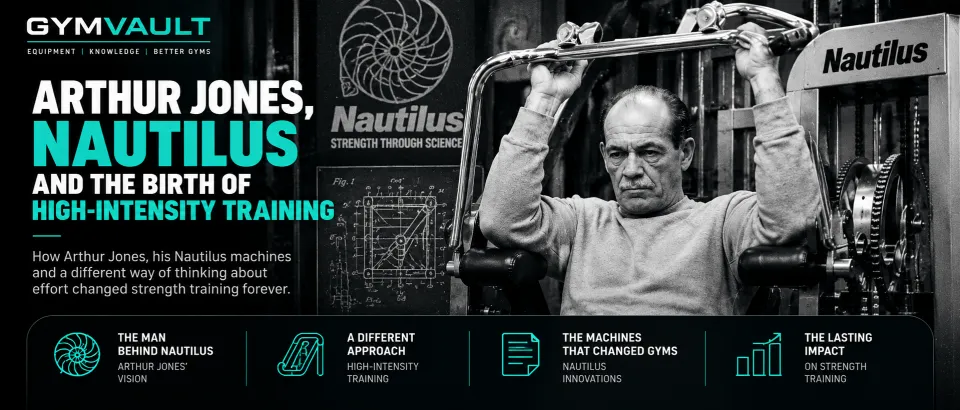
Walk into almost any commercial gym and you will see the influence of Arthur Jones, even if you have never heard his name. The single-station machine, built around one movement with a padded seat and a guided path, owes much of its place on the gym floor to him.
Jones was also one of the loudest advocates of a simple, uncomfortable idea: that how hard you train matters more than how long you train. Half a century later, that idea is still argued over in gyms and in research journals. This article looks at both halves of his legacy, the machines and the method, and at what the evidence now says about each.
A different kind of machine
Jones began selling his first Nautilus machines in 1970. Trade reports at the time of his death described how he used "Nautilus shell-shaped cams" on single-station machines so that users could exert force through a full range of motion (Chain Store Age, 2007). A local history of the company recalls that the name came from that spiral cam, which looked a little like a nautilus seashell (Long, 2019).
The problem Jones was trying to solve is one every lifter has felt. Your muscles are not equally strong at every point of a movement. A barbell curl feels easy at the bottom, hard in the middle and easy again at the top, because the weight's leverage on your elbow changes as your forearm moves. Resistance that stays the same in kilograms does not stay the same at the joint.
A cam is a pulley with a changing radius. As it rotates, the distance between the cable or chain and the pivot changes, so the turning effect of the weight stack changes too. In principle, a well-shaped cam can make a machine heavier where you are strong and lighter where you are weak. Jones built that principle into a range of machines that isolated one movement each, with seats, pads and belts to hold the body in position.
Brief, infrequent and intense
Jones's training philosophy was as distinctive as his machines. He argued for short workouts of a few exercises, usually one set each, with every set continued until another repetition was impossible. Repetitions were to be smooth and controlled rather than bounced, and there had to be enough rest between sessions for the body to adapt. Followers often summarised the approach as "brief, infrequent and intense", and it became known as high-intensity training, or HIT.
He promoted the method with dramatic demonstrations, most famously work in Colorado in the early 1970s with the bodybuilder Casey Viator, who had won the 1971 Mr. America title (Long, 2019). Demonstrations like these made powerful marketing. With a handful of participants and no control group, though, they could not show what caused the results, and they are not evidence in the scientific sense.
HIT outlived the publicity. It was popularised in the 1970s and 1980s by Mike Mentzer, and in the 1990s it shaped the training of six-time Mr. Olympia Dorian Yates.
From the gym to the clinic
Jones sold his interest in Nautilus in 1986 (Spa Business, 2007; Chain Store Age, 2007). He went on to build medical exercise and testing machines under the MedX name in Ocala, Florida (Long, 2019).
That work produced one of the more interesting studies to carry his name. In a 1989 paper with researchers at the University of Florida, Jones and colleagues used a new machine that stabilised the pelvis so that the lumbar extensor muscles of the lower back could be trained and tested in isolation. Fifteen healthy adults trained once a week for ten weeks, performing 6 to 15 repetitions of lumbar extension to volitional fatigue, plus periodic maximal isometric efforts. Their isometric lumbar extension strength rose at every angle tested, by 102% at full extension and 42% at full flexion, while a control group did not change (Pollock et al., 1989).
The authors were careful to say that the size of those gains reflected how untrained these muscles were to begin with. The study shows that a very small weekly dose can produce large strength gains in a poorly trained muscle. It does not show that once a week is best for everyone.
What the research says now
Jones made confident claims at a time when there were few controlled studies to test them. There are now hundreds. Here is how his main ideas have fared.
One set versus several
Single sets work. Several sets usually work better. In a meta-regression of 14 studies, two to three sets per exercise were associated with 46% greater strength gains than a single set, in both trained and untrained people (Krieger, 2009). A companion analysis of muscle growth found that multiple sets were associated with 40% larger hypertrophy effect sizes than one set (Krieger, 2010).
A later trial in resistance-trained men compared one, three and five sets per exercise, three times a week for eight weeks. Strength gains were similar across all three groups, so the shortest programme was the most time-efficient for strength. Muscle growth, however, was greater with higher volumes at most of the sites measured (Schoenfeld et al., 2019). For strength in trained lifters, a systematic review concluded that a single set of 6 to 12 repetitions at roughly 70–85% of one-repetition maximum, two to three times a week and taken to failure, produced "suboptimal, yet significant" gains in the squat and bench press (Androulakis-Korakakis et al., 2020).
So Jones was right that a single hard set is not wasted effort. The evidence does not support the stronger claim that extra sets are pointless, especially when muscle size is the goal.
Training to failure
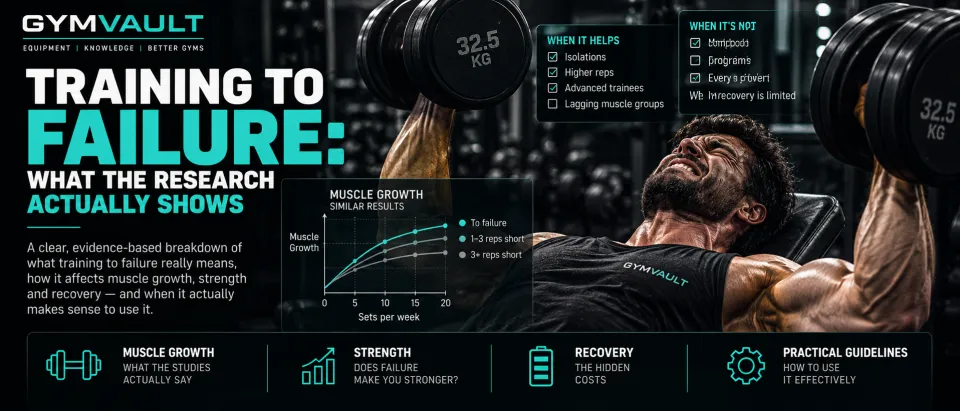
Jones treated failure as non-negotiable. A 2022 meta-analysis of 15 studies found no significant difference in strength or muscle growth overall between training to failure and stopping short of it, although failure training showed a small advantage for hypertrophy in a subgroup of trained participants (Grgic et al., 2022). Another meta-analysis found no advantage for training to momentary muscular failure specifically over non-failure training for hypertrophy (Refalo et al., 2023).
The fairest reading is that effort matters, but the last repetition does not have to be a failed one. We look at this in detail in Training to failure: what the research actually shows.
Do cams match human strength?
This is where the original engineering claim has been tested most directly. When researchers measured eight variable-cam knee extension machines from six manufacturers, the machines' resistance profiles were highly variable and consistently flatter than the real angle–torque relationship of the knee extensors (Folland and Morris, 2008). An earlier analysis of the Nautilus leg curl found that its resistance torque pattern was not similar to the torque pattern of the knee flexors (Pizzimenti, 1992).
Cams improve on a fixed-radius pulley in some movements and not in others. They are an approximation, and how close the approximation is depends on the specific machine. We explain why in Resistance curves and why the cam matters.
Machines versus free weights
Jones believed his machines were superior. The 2026 American College of Sports Medicine position stand, an overview of 137 systematic reviews, found that equipment type did not consistently affect training outcomes, and neither did training to momentary muscle fatigue (Currier et al., 2026). Machines are not magic, and they are not inferior. They are tools with particular strengths.
His real legacy: the machine itself
Strip away the marketing and the arguments, and what remains is a very useful piece of equipment. A well-designed machine guides the path of the load, supports the body, lets you change resistance in seconds and lets you work hard without a spotter. For a busy commercial floor, a hotel gym or a residential facility, that combination of safety, simplicity and consistency is valuable.
The lineage continued in Jones's family. Hammer Strength, founded by his son Gary Jones in 1989, became known for plate-loaded machines with independent, converging arms. Nautilus still exists as a brand. Machines from both are among the most recognisable on the pre-owned market because their heavy frames are built to last, and what wears out (cables, bearings, grips and upholstery) can be replaced.


How to use Jones's ideas today
- Keep effort high. Most of your working sets should end close to failure, roughly zero to three repetitions short. Machines make this safer, because you can stop at any point without a spotter.
- Use more than one set when size is the goal. One hard set per exercise is a respectable minimum. Two or three sets will usually build more muscle, if you can recover from them.
- Move under control through a full range. This was good advice in 1970 and remains good advice.
- Choose a frequency you can sustain. Once a week can work, and two or three sessions per muscle often suit people better. Consistency over months matters more than the perfect split.
- Judge machines individually. A cam is only as good as its design and its condition. A worn cable or a stiff pivot changes how a machine feels long before it fails.
References
- Androulakis-Korakakis P, Fisher JP, Steele J. The minimum effective training dose required to increase 1RM strength in resistance-trained men: a systematic review and meta-analysis. Sports Med. 2020;50(4):751–765. doi:10.1007/s40279-019-01236-0
- Chain Store Age. Nautilus inventor Arthur Jones dies. 31 August 2007. chainstoreage.com
- Currier BS, D'Souza AC, Singh MAF, et al. American College of Sports Medicine position stand. Resistance training prescription for muscle function, hypertrophy, and physical performance in healthy adults: an overview of reviews. Med Sci Sports Exerc. 2026;58(4):851–872. doi:10.1249/MSS.0000000000003897
- Folland J, Morris B. Variable-cam resistance training machines: do they match the angle–torque relationship in humans? J Sports Sci. 2008;26(2):163–169. doi:10.1080/02640410701370663
- Grgic J, Schoenfeld BJ, Orazem J, Sabol F. Effects of resistance training performed to repetition failure or non-failure on muscular strength and hypertrophy: a systematic review and meta-analysis. J Sport Health Sci. 2022;11(2):202–211. doi:10.1016/j.jshs.2021.01.007
- Krieger JW. Single versus multiple sets of resistance exercise: a meta-regression. J Strength Cond Res. 2009;23(6):1890–1901. doi:10.1519/JSC.0b013e3181b370be
- Krieger JW. Single vs. multiple sets of resistance exercise for muscle hypertrophy: a meta-analysis. J Strength Cond Res. 2010;24(4):1150–1159. doi:10.1519/JSC.0b013e3181d4d436
- Long R. Remembering Arthur Jones and Nautilus. The Beacon (DeLand, Florida). 2 August 2019. beacononlinenews.com
- Pizzimenti MA. Mechanical analysis of the Nautilus leg curl machine. Can J Sport Sci. 1992;17(1):41–48. PubMed 1322768
- Pollock ML, Leggett SH, Graves JE, Jones A, Fulton M, Cirulli J. Effect of resistance training on lumbar extension strength. Am J Sports Med. 1989;17(5):624–629. doi:10.1177/036354658901700506
- Refalo MC, Helms ER, Trexler ET, Hamilton DL, Fyfe JJ. Influence of resistance training proximity-to-failure on skeletal muscle hypertrophy: a systematic review with meta-analysis. Sports Med. 2023;53(3):649–665. doi:10.1007/s40279-022-01784-y
- Schoenfeld BJ, Contreras B, Krieger J, et al. Resistance training volume enhances muscle hypertrophy but not strength in trained men. Med Sci Sports Exerc. 2019;51(1):94–103. doi:10.1249/MSS.0000000000001764
- Spa Business. Arthur Jones, founder of Nautilus, dies. 2 October 2007. spabusiness.com
Further reading
- Resistance curves and why the cam matters
- How strength machines load your muscles
- Browse Nautilus equipment
- Browse Hammer Strength equipment
This article is general information about training and equipment. It is not medical advice. Speak to a qualified professional before starting a new exercise programme, particularly if you have an injury, a health condition or have been inactive.