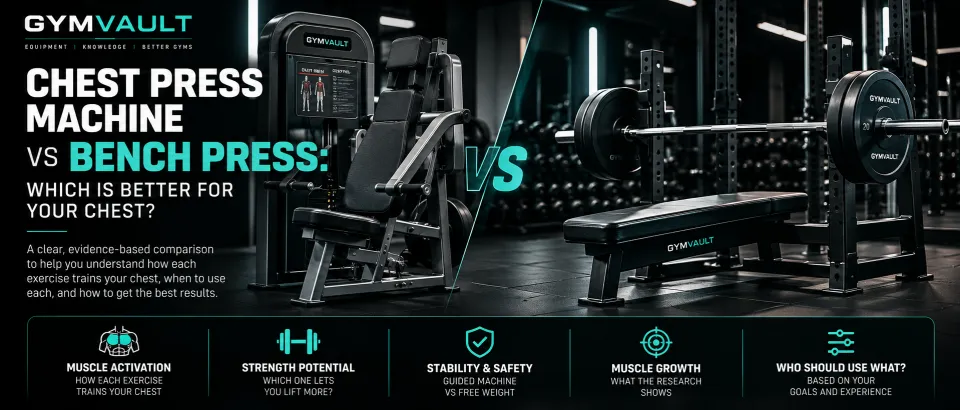
"How much do you bench?" is one of the most familiar questions in any gym. The seated chest press machine, meanwhile, is often treated as the bench press's easier cousin. The research suggests neither reputation is quite deserved.
The short answer
For building chest muscle, the chest press machine and the bench press work about equally well when you train them equally hard. For maximal bench press strength, the bench press wins, because strength is specific to the movement you practise. Most people do best with both, or with whichever they can train hard, safely and consistently.
What training studies show
The strongest evidence comes from studies that trained people on machines or free weights for weeks and measured the results.
- Pooled evidence. A 2023 meta-analysis of 13 studies directly comparing free-weight and machine training found no difference in muscle growth or in overall strength. Strength gains were specific: people improved most on the type of equipment they trained with (Haugen et al., 2023).
- Trained on one, tested on both. In an eight-week study of 46 young men and women, free-weight and machine training increased muscle thickness similarly. The only strength difference was on the machine bench press, which improved more in the machine group, 13.9% against 8.6% (Schwanbeck et al., 2020).
- Beginners. In a 10-week trial of novice men, the groups trained with machines, with free weights, or with machines and then free weights. Chest press machine strength, dumbbell bench press strength and chest circumference improved similarly in all three groups, and switching from machines to free weights halfway caused no setback (Aerenhouts and D'Hondt, 2020).
- Smith machine vs free bench press. When active young adults trained the bench press for eight weeks with free weights or on a Smith machine, each group improved more when tested on its own equipment, and pectoralis major size, measured in the men, increased similarly in both groups (Marcos-Frutos et al., 2025).
The pattern is consistent. Muscle responds to hard work, while strength also depends on practising the specific lift.
Muscle activity: what EMG studies show
Electromyography (EMG) measures how strongly a muscle is activated during an exercise. It is useful for comparing exercises, but it is not the same as measuring muscle growth.
- In 20 experienced lifters, a seated chest press machine and a barbell bench press produced broadly similar muscle activity. The upper (clavicular) chest was slightly more active in the seated chest press with a neutral grip than in the wide-grip bench press. The authors concluded that exercise selection "should not be based exclusively on muscle activation" (Muyor et al., 2023).
- In trained men at their one-repetition maximum, chest and front shoulder activity did not differ between Smith machine, barbell and dumbbell presses, while biceps activity rose as the press became less stable (Saeterbakken et al., 2011).
- In a comparison of free-weight and Smith machine bench presses, the free-weight bench press produced greater activation of the middle (lateral) deltoid, with no reported difference for the chest or front shoulder (Schick et al., 2010).
The extra stabilising work of free weights shows up mainly in the smaller muscles around the shoulder and arm, not in the chest itself.
Which part of the chest does each work?
A flat press, whether on a bench or a seated machine with horizontal handles, works mainly the middle and lower (sternal and costal) parts of the pectoralis major, along with the front of the shoulders and the triceps.
Changing the angle shifts the emphasis:
- In 30 trained adults pressing at five bench angles, middle and lower chest activity was highest on a flat bench and fell as the bench was inclined. Front shoulder activity rose from 30 degrees upwards. Upper chest activity did not differ significantly between flat and 45 degrees, and was lowest at 60 degrees (Rodríguez-Ridao et al., 2020).
- Another study found higher upper chest activity at 44 and 56 degrees than on a flat bench (Trebs et al., 2010), and a third found it higher at 30 and 45 degrees only in part of the lift (Lauver et al., 2016).
So the evidence that an incline targets the upper chest is mixed, while the shift towards the front shoulders as the angle rises is clear. Many programmes combine a flat press with an incline press, or a press with a fly, and that is a sensible default.


Why can the machine chest press feel harder?
Many people find a weight on the chest press machine harder than the same number on the bench press, or the reverse. Several things can explain it.
- The number is not the load. On a selectorized machine, cables, pulleys and often a cam sit between the stack and the handles, and on a plate-loaded machine the lever changes the load. A "60" on one machine is not 60 kg at your hands, and it is not the same as a "60" on another model. We explain ratios in Cable machine pulley ratios explained.
- The resistance curve. A cam or lever can make the hardest point of the lift fall where you are weaker than on the bench press, as we describe in Resistance curves and why the cam matters.
- Your position. Seat height and handle position change your leverage, so the same machine can feel very different from one setting to the next.
- A fixed path. A machine moves the handles along a path set by its designer. If that path does not suit your build, the press can feel awkward and weaker, whereas a bar or dumbbells let your arms find their own path.
- Practice. You are strongest in the movement you have practised most.
Studies show how much the numbers can differ. In one, the same experienced lifters had an average one-repetition maximum of 85 kg on a wide-grip bench press, 79 kg on a seated chest press with a pronated grip, and 70 kg with a neutral grip (Muyor et al., 2023). In another, trained men lifted about 3% more on a barbell bench press than on a Smith machine (Saeterbakken et al., 2011). These figures are specific to the equipment used in those studies.
When to use each
| Situation | Better choice |
|---|---|
| You want a bigger bench press for sport, testing or competition | The bench press, because strength is specific |
| You want a bigger chest | Either; many lifters use both |
| You train alone and want to push close to failure | A machine, where a set can end safely |
| You are new to training | A machine is easy to learn; add the bench press as your skill grows |
| A movement feels uncomfortable | Try a different grip, handle position or angle, and get professional advice for pain |
For gym owners, the same logic applies to the floor. A selectorized chest press is the safer choice for unsupervised members, plate-loaded presses suit experienced lifters, and benches belong in staffed areas with safety arms or spotters. We compare the two machine types in Plate-loaded vs pin-loaded machines. We look at how to plan this in Commercial gym equipment list.
Using both in a programme
A simple way to combine them is to start a chest session with the bench press, using moderate to heavy weights and stopping a repetition or two short of failure. Follow it with a machine press, where you can push closer to failure safely, and finish with a fly or an incline movement. Count both presses towards your weekly chest sets, as we explain in Hypertrophy training: what the research says.


The bottom line
The chest press machine is not a lesser exercise. For chest size, it does the same job as the bench press when trained as hard. Choose the bench press when the bench press itself is the goal, choose the machine when safety, simplicity or training to failure matter more, and use both when you can.
References
- Aerenhouts D, D'Hondt E. Using machines or free weights for resistance training in novice males? A randomized parallel trial. Int J Environ Res Public Health. 2020;17(21):7848. doi:10.3390/ijerph17217848
- Haugen ME, Vårvik FT, Larsen S, Haugen AS, van den Tillaar R, Bjørnsen T. Effect of free-weight vs. machine-based strength training on maximal strength, hypertrophy and jump performance: a systematic review and meta-analysis. BMC Sports Sci Med Rehabil. 2023;15(1):103. doi:10.1186/s13102-023-00713-4
- Lauver JD, Cayot TE, Scheuermann BW. Influence of bench angle on upper extremity muscular activation during bench press exercise. Eur J Sport Sci. 2016;16(3):309–316. doi:10.1080/17461391.2015.1022605
- Marcos-Frutos D, Miras-Moreno S, Márquez G, García-Ramos A. Comparative effects of the free weights and Smith machine squat and bench press: the important role of specificity for strength adaptations. Int J Sports Physiol Perform. 2025;20(2):292–300. doi:10.1123/ijspp.2024-0274
- Muyor JM, Rodríguez-Ridao D, Oliva-Lozano JM. Comparison of muscle activity between the horizontal bench press and the seated chest press exercises using several grips. J Hum Kinet. 2023;87:23–34. doi:10.5114/jhk/161468
- Rodríguez-Ridao D, Antequera-Vique JA, Martín-Fuentes I, Muyor JM. Effect of five bench inclinations on the electromyographic activity of the pectoralis major, anterior deltoid, and triceps brachii during the bench press exercise. Int J Environ Res Public Health. 2020;17(19):7339. doi:10.3390/ijerph17197339
- Saeterbakken AH, van den Tillaar R, Fimland MS. A comparison of muscle activity and 1-RM strength of three chest-press exercises with different stability requirements. J Sports Sci. 2011;29(5):533–538. doi:10.1080/02640414.2010.543916
- Schick EE, Coburn JW, Brown LE, et al. A comparison of muscle activation between a Smith machine and free weight bench press. J Strength Cond Res. 2010;24(3):779–784. doi:10.1519/JSC.0b013e3181cc2237
- Schwanbeck SR, Cornish SM, Barss T, Chilibeck PD. Effects of training with free weights versus machines on muscle mass, strength, free testosterone, and free cortisol levels. J Strength Cond Res. 2020;34(7):1851–1859. doi:10.1519/JSC.0000000000003349
- Trebs AA, Brandenburg JP, Pitney WA. An electromyography analysis of 3 muscles surrounding the shoulder joint during the performance of a chest press exercise at several angles. J Strength Cond Res. 2010;24(7):1925–1930. doi:10.1519/JSC.0b013e3181ddfae7
Further reading
- Free weights vs machines: what the evidence says
- How strength machines load your muscles
- Smith machine vs barbell squat
- Browse chest and shoulder machines
- Browse benches and racks
This article is general information about training and equipment. It is not medical advice. Speak to a qualified professional before starting a new exercise programme, particularly if you have an injury, a health condition or have been inactive.